

Inheriting property in Florida often comes during one of life’s most difficult transitions. The loss of a loved one. While grieving, executors and heirs must navigate complex legal requirements, including obtaining a date-of-death appraisal for inherited property. This appraisal establishes the property’s fair market value as of the date the owner passed away, serving critical purposes for IRS tax reporting and Florida probate court proceedings. Understanding how to obtain this appraisal, what it costs, and how long the process takes helps executors fulfill their responsibilities efficiently while protecting heirs from unnecessary tax liability. The Jacksonville real estate market, like all Florida markets, requires specific knowledge of state probate laws and local county procedures when handling inherited property appraisals. In this blog post, Jacksonville real estate expert Phil Aitken discusses how to obtain a date-of-death appraisal for inherited property in Florida, including costs, timelines, and county-specific requirements.
Key Takeaways
- Florida probate law requires hiring a state-certified residential or general appraiser licensed through Florida DBPR to determine fair market value as of the date of death for IRS reporting
- Date-of-death appraisal costs in Florida range from $350-550 in rural counties to $600-1,200 in metro areas like Miami-Dade and Broward, with timelines varying from 5-20 business days depending on region
- The stepped-up basis established by this appraisal can save heirs thousands in capital gains taxes when selling inherited property, making it essential for tax compliance
- Working with a Florida real estate expert who understands local probate procedures and appraisal requirements helps executors navigate county-specific court filing requirements efficiently
To get a date-of-death appraisal for an inherited property in Florida, the personal representative must hire a Florida state-certified appraiser who will determine the property’s fair market value as of the owner’s date of death. This appraisal is required for IRS stepped-up basis calculations and often for probate court proceedings in Florida.
To Discuss Your Home Sale or Purchase, Call or Text Today and Start Packing!
Phil Aitken specializes in helping Florida families navigate inherited property sales, having personally served as a personal representative for his own family’s estate. With 20+ years of Jacksonville real estate experience and 700+ transactions, Phil understands the intersection of probate requirements, appraisal needs, and market timing—helping executors make informed decisions during difficult transitions.
What Is a Date-of-Death Appraisal and Why Is It Required in Florida?
A date-of-death appraisal is a professional real estate valuation that establishes a property’s fair market value as of the exact date the owner passed away. Unlike standard home appraisals that determine current value, this specialized appraisal looks backward to establish what the property was worth on a specific historical date. Florida personal representatives need this valuation for two primary purposes: satisfying IRS requirements for the stepped-up basis calculation and meeting Florida probate court inventory requirements in many jurisdictions throughout the state.
The IRS requires date-of-death appraisals to establish the stepped-up basis for inherited property under Internal Revenue Code Section 1014. This provision adjusts the property’s tax basis from the original purchase price to the fair market value at death, potentially saving heirs substantial capital gains taxes when they eventually sell. For example, if the deceased purchased a home in Jacksonville Beach for $150,000 in 1995 and it was worth $425,000 at death in 2024, the stepped-up basis becomes $425,000. When heirs sell the property for $450,000, they only pay capital gains tax on $25,000 in appreciation rather than $300,000—a massive tax advantage that proper documentation protects.
Florida probate courts often require date-of-death appraisals as part of the estate inventory filing under Florida Statute Chapter 733. While requirements vary by county, Duval County Probate Court and most other Florida jurisdictions expect personal representatives to provide accurate property valuations when submitting the estate inventory within 60 days of receiving Letters of Administration. This appraisal also becomes crucial if the personal representative needs court approval to sell estate property below 90% of appraised value or when multiple heirs dispute property distribution decisions.
What Fair Market Value Means in Florida Estate Context
Fair market value represents the price a willing buyer would pay a willing seller in an arm’s-length transaction, with neither party under compulsion to act. For date-of-death appraisals in Northeast Florida real estate markets, this means the appraiser must research comparable property sales that occurred around the date of death, analyze market conditions as they existed at that time, and make adjustments for the subject property’s specific characteristics. The appraiser cannot use current market data or recent sales that occurred months after the death date, making this valuation more complex than standard appraisals.
The Stepped-Up Basis Tax Advantage for Florida Heirs
The stepped-up basis is one of the most significant tax benefits in estate law. When heirs inherit property, the IRS allows them to “step up” the property’s cost basis from what the deceased originally paid to the fair market value at death.
Key benefits include:
- Elimination of decades of accumulated appreciation from taxable gains
- Substantial capital gains tax savings for long-held Florida properties
- Reduced tax burden for heirs in high-appreciation markets
This adjustment eliminates decades of built-up appreciation from the taxable gain calculation. For Florida properties that have appreciated substantially over long ownership periods—common in markets like Ponte Vedra, Nocatee, and historic Jacksonville neighborhoods like Riverside and Avondale—the tax savings can reach tens of thousands of dollars. Without proper date-of-death appraisal documentation, the IRS may challenge heirs’ claimed basis, potentially triggering audits and forcing them to pay tax on the full appreciation from the original purchase date.
When Florida Probate Courts Require Date-of-Death Appraisals
Most Florida probate courts require appraisals when the estate includes real property, though specific requirements vary by county and estate complexity. Summary administration (for estates under $75,000) may not always require formal appraisals, while formal administration typically does. Some Florida counties accept property tax assessor valuations for uncontested estates, but these valuations rarely satisfy IRS requirements and often understate true market value. Courts also require appraisals when personal representatives seek permission to sell property below appraised value or when heirs dispute proposed sale prices.
“Having served as the personal representative for my own family’s estate, I understand firsthand how overwhelming the appraisal requirement can feel during grief. That experience drives my commitment to helping Florida executors navigate these technical requirements with clarity and compassion.” – Phil Aitken
Date-of-Death Appraisal Costs in Florida: What to Expect by County
Date-of-death appraisal costs in Florida vary significantly based on property location, type, and complexity. Metro areas like Miami-Dade, Broward, Palm Beach, Tampa’s Hillsborough County, and Orlando’s Orange County typically charge $600-1,200 for residential property appraisals due to higher appraiser demand, complex comparable sales research, and higher cost of living. Mid-size markets including Duval County (Jacksonville), Lee County (Fort Myers), Collier County (Naples), Sarasota, and Polk County (Lakeland) generally range from $450-800 for residential appraisals. Rural Florida counties often offer the most affordable options at $350-550, reflecting lower appraiser overhead and simpler market analysis requirements.
Commercial property appraisals cost substantially more, typically $1,500-3,000 in metro areas, $1,200-2,200 in mid-size markets, and $900-1,500 in rural counties. Waterfront properties, luxury estates over $1 million, agricultural land, and properties with unique features (historic designation, environmental issues, easements) command premium pricing due to the specialized expertise and additional research required. Appraisers may charge extra for retrospective appraisals completed months or years after the date of death, as reconstructing historical market conditions requires significantly more research time.
Cost Breakdown: Metro vs Mid-Size vs Rural Florida Counties
The geographic cost disparity reflects fundamental differences in appraiser workload and market complexity. Metro areas have more active real estate markets with thousands of recent sales to analyze, making comparable selection more time-intensive. These markets also experience higher appraiser demand, allowing professionals to command premium rates. Mid-size markets like Jacksonville offer a balance—sufficient market activity to provide good comparable sales data without the overwhelming volume of major metros. Rural counties have simpler markets with fewer recent sales, making research faster but sometimes requiring appraisers to look at wider geographic areas or older comparable sales to find appropriate matches.
Factors That Increase Appraisal Costs in Florida
Several factors push appraisal costs above typical ranges:
- Property access challenges requiring special entry arrangements
- Properties with tenant occupancy or restricted community access
- Homes in poor condition needing detailed deterioration documentation
- Properties with significant unpermitted additions or renovations
- Boundary disputes or survey discrepancies requiring extra research
Seasonal factors also affect pricing. Hurricane season (June through November) often sees appraiser availability decrease as professionals work on insurance claims, potentially driving up prices for estate appraisals during these months.
Commercial and Specialty Property Appraisal Pricing
Commercial properties require appraisers with general certification (rather than residential certification) and command significantly higher fees. A small retail building, office condo, or mixed-use property in Jacksonville might cost $1,500-2,500 to appraise at date of death, while larger commercial assets like apartment buildings, shopping centers, or industrial facilities can exceed $5,000. Agricultural properties, including Florida citrus groves, cattle ranches, and timberland, require appraisers with specialized agricultural certification and knowledge of complex income valuation methods. These assignments typically start at $2,000 and increase based on acreage and operation complexity.
How Long Does a Date-of-Death Appraisal Take in Florida?
Date-of-death appraisal timelines in Florida typically range from 5-20 business days depending on property location, appraiser workload, and assignment complexity. Mid-size markets like Duval County (Jacksonville area), Fort Myers, Naples, and Sarasota generally see 7-14 business day turnaround times under normal conditions. Metro markets including Miami-Dade, Broward, Tampa/Hillsborough, and Orange County (Orlando) often require 10-20 business days due to higher appraiser workloads and more extensive comparable sales research requirements in active real estate markets with thousands of recent transactions to analyze.
Rural Florida counties frequently offer the fastest service at 5-10 business days since appraisers in these areas typically maintain lighter schedules and analyze simpler markets with fewer comparable sales to review. However, rural markets sometimes present unique challenges—if comparable sales are sparse, appraisers may need to expand their search radius or go back further in time to find appropriate matches, potentially extending the timeline despite lower overall workload.
Seasonal factors significantly impact appraisal timelines throughout Florida. Peak estate settlement season runs January through April, following holiday deaths and year-end passings when families often tackle probate proceedings after the new year begins. During these months, appraiser availability tightens and turnaround times can extend 5-10 business days beyond typical estimates. Hurricane season (June through November) also affects timelines as licensed appraisers often handle insurance claim inspections, reducing availability for estate appraisal assignments and potentially adding 7-14 days to normal completion schedules.
Typical Turnaround Times by Florida Region
Northeast Florida (including Jacksonville, St. Augustine, Jacksonville Beach, Orange Park, and the six-county region) typically offers 7-12 business day turnaround times for residential date-of-death appraisals. The region benefits from an adequate supply of certified appraisers serving Duval, St. Johns, Clay, Nassau, Baker, and Putnam counties without the overwhelming demand pressure seen in South Florida metros. Coastal markets like Ponte Vedra Beach and Atlantic Beach sometimes require an additional 2-3 days due to higher property values and more complex waterfront comparable analysis requirements.
South Florida metro areas (Miami-Dade, Broward, Palm Beach) consistently show the longest timelines at 12-20 business days due to intense appraiser demand in one of the nation’s most active real estate markets. Central Florida markets around Orlando and Tampa fall in the 10-16 business day range, while Southwest Florida (Naples, Fort Myers, Sarasota) varies from 8-15 days depending on season and property type. The Panhandle and North Central Florida regions offer the fastest service at 5-10 days in most circumstances.
Factors That Can Extend Your Appraisal Timeline
Several complications can add days or weeks to standard appraisal timelines. Property access issues top the list—if the deceased lived alone and the home is now vacant, the personal representative must arrange key access, security code information, and potentially coordinate with neighbors or alarm companies. Properties with tenant occupancy require scheduling around tenant availability, often adding 3-7 days. Gated community properties may need advance approval for appraiser entry, and homes in disrepair or with hoarding situations require extra inspection time.
Comparable sales research challenges extend timelines when the property is unique, highly customized, or located in neighborhoods with few recent sales. Appraisers working on luxury waterfront properties in exclusive communities like Ponte Vedra or historic homes in Riverside’s Avondale district may need additional time to identify appropriate comparables and make complex adjustments for differences in location, condition, features, and sale timing.
Retrospective Appraisals: When You’re Getting This Done Years Later
Retrospective date-of-death appraisals—those completed months or years after the owner passed away—present unique challenges that extend timelines significantly. When an executor delays obtaining the appraisal or heirs later discover they need documentation for tax purposes years after death, the appraiser must reconstruct market conditions as they existed on the historical date of death. This research requires analyzing comparable sales that occurred around the death date (now several years old), reviewing historical MLS data, consulting archived property records, and potentially interviewing real estate professionals who were active in the market at that time.
Step-by-Step Process: How to Get a Date-of-Death Appraisal in Florida
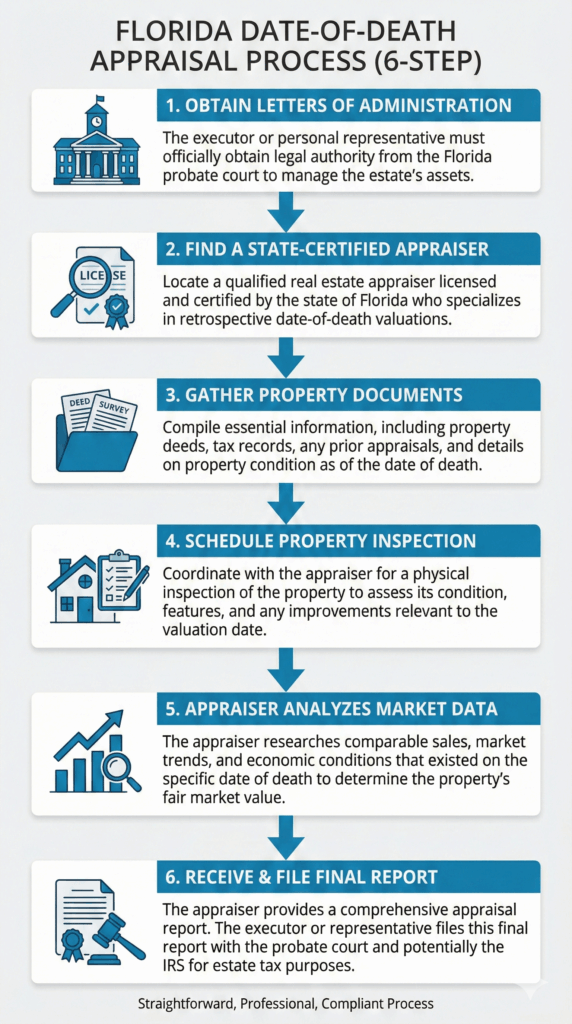
Obtaining a date-of-death appraisal in Florida follows a specific process designed to ensure proper documentation for IRS and probate court requirements. The personal representative (executor) manages this process, coordinating between the estate attorney, the selected appraiser, and sometimes multiple heirs who may have input on decisions. Understanding each step helps executors move efficiently through this requirement while avoiding common mistakes that could delay probate proceedings or create tax documentation problems later. The process typically spans 2-4 weeks from initial appraiser contact to receiving the final written report suitable for filing with Florida probate courts and IRS estate tax returns when applicable.
Florida Date-of-Death Appraisal Process
Obtain Letters of Administration
Obtain legal authority from the Florida probate court to act on behalf of the estate and hire professionals.
Research & Contact Appraiser
Select and hire a qualified, State-Certified appraiser by verifying their credentials through the Florida DBPR.
Gather Property Documents
Provide the appraiser with the death certificate, property deed, and recent tax records to begin the valuation.
Appraiser Inspects Property
The appraiser conducts an on-site visit to inspect the home’s condition, size, features, and any issues affecting value.
Appraiser Analyzes Market Data
Using historical data, the appraiser researches comparable sales from around the date of death to determine fair market value.
Receive Report & File with Court
Receive the final written appraisal report and file it with the probate court as part of the estate inventory within 60 days.
Step 1: Confirm Your Authority as Personal Representative
Before hiring an appraiser, the personal representative must obtain Letters of Administration from the appropriate Florida probate court—typically the circuit court in the county where the deceased resided. These letters provide legal authority to act on behalf of the estate, including hiring professionals and accessing the deceased’s property. Florida Statute 733.602 grants personal representatives the authority to engage necessary professional services, but this authority only becomes effective once the court issues the official letters. Most Florida counties process Letters of Administration within 3-6 weeks after the estate petition is filed, though timelines vary by jurisdiction and estate complexity. The personal representative should secure original or certified copies of these letters, as the appraiser will likely request documentation proving authority before beginning the assignment.
Step 2: Find a Florida State-Certified Appraiser
Selecting a qualified appraiser requires verifying credentials through the Florida Department of Business and Professional Regulation (DBPR). Florida offers two relevant appraiser license types: State-Certified Residential Appraisers (can appraise residential properties of any value) and State-Certified General Appraisers (can appraise any property type including commercial). For most single-family homes, condominiums, and residential lots, a State-Certified Residential Appraiser suffices. Commercial properties, apartment buildings over four units, agricultural land, or mixed-use properties require a State-Certified General Appraiser.
Executors can verify appraiser credentials by visiting the Florida DBPR website and searching the licensee database by name or license number. Check that the license is active (not expired or suspended), review any disciplinary history, and confirm the appraiser holds the appropriate certification level for your property type. When interviewing potential appraisers, ask about their experience with date-of-death appraisals specifically, familiarity with the local market where the property is located, typical turnaround time, cost including any additional fees, and whether they’re comfortable with retrospective appraisals if the assignment involves a historical valuation date.
Step 3: Provide Required Property Documentation
Once hired, the appraiser needs specific information about the property and the estate:
- Certified copy of the death certificate showing exact date of death
- Property deed or title documentation proving ownership
- Recent property tax statements from the county
- Any prior appraisals or assessments from the past few years
- Photographs of the property’s condition around the date of death if available
For properties with recent renovations, provide permit records and contractor invoices. If the deceased owned the property with a spouse who survives, clarify the ownership structure (tenants by entirety, joint tenants, community property, etc.) as this affects what portion requires appraisal.
The personal representative should also provide the appraiser with access information—keys, alarm codes, gate access codes for communities, and contact information for neighbors or property managers if relevant. Clear communication about property access timing prevents unnecessary delays. Some appraisers request utility bills or homeowner association documents to understand property expenses and community features that may affect value.
Step 4: Schedule the Property Inspection
The appraiser schedules a property visit to inspect the home’s condition, measure square footage, document features and amenities, photograph the property, and note any damage, deferred maintenance, or functional issues that affect value. For date-of-death appraisals, the appraiser needs to understand the property’s condition as of the death date, which can be challenging if months or years have passed. The personal representative should inform the appraiser of any significant changes made after death—such as repairs, renovations, or deterioration—so the appraiser can adjust the valuation appropriately.
The inspection typically takes 30-60 minutes for standard single-family homes and longer for large properties or complex estates with multiple structures, extensive acreage, or unique features. The personal representative or designated estate representative should be present to provide property access, answer questions about the home’s history and features, and explain any unusual conditions. If the property is occupied by tenants or surviving family members, coordinate inspection timing that respects their schedules while meeting appraisal timeline requirements.
Step 5: Appraiser Researches Comparable Sales and Market Conditions
After inspecting the property, the appraiser researches comparable sales that occurred around the date of death in the same or similar neighborhoods. The appraiser seeks recently sold properties with similar characteristics—comparable square footage, bedroom and bathroom count, age, condition, lot size, and location desirability. Ideally, the appraiser finds comparable sales that closed within three to six months of the date of death, though market conditions and property type may necessitate looking at older sales or expanding the geographic search area.
For Jacksonville and Northeast Florida real estate markets, appraisers typically analyze sales data from the Multiple Listing Service (MLS), public property records, and their own comparable sales databases. They make dollar adjustments for differences between the subject property and each comparable—adding value for superior features the subject property has or subtracting value for features the comparables have that the subject lacks. This adjustment process accounts for differences in square footage, garage spaces, pool presence, waterfront location, view quality, condition, updates, and numerous other factors that affect market value.
Step 6: Receive and File the Appraisal Report with Probate Court
The appraiser delivers a completed Uniform Residential Appraisal Report (URAR Form 1004) or equivalent format documenting their analysis, comparable sales, adjustments, and final value conclusion as of the date of death. This report typically spans 20-40 pages including property photos, comparable sales data, neighborhood and market analysis, and the appraiser’s certification that they followed Uniform Standards of Professional Appraisal Practice (USPAP). The final page includes the appraiser’s signature, license number, and certification statement attesting to the report’s accuracy and compliance with professional standards.
The personal representative files this appraisal report with the Florida probate court as part of the estate inventory, typically due within 60 days of receiving Letters of Administration. Some counties require the original appraisal with original signature, while others accept certified copies or electronic filings. Check local court rules for specific filing requirements. The personal representative should also provide copies to the estate attorney, the tax preparer handling any required estate tax returns, and potentially to heirs if estate distribution involves property division decisions requiring documented values.
How to Find and Vet a Qualified Florida Estate Appraiser
Finding a qualified estate appraiser in Florida requires understanding appraiser credentials, knowing where to search for licensed professionals, and asking the right vetting questions before making a hiring decision. Unlike real estate agents who can provide comparative market analyses (CMAs), date-of-death appraisals must be completed by state-licensed appraisers who follow strict USPAP standards and maintain professional liability insurance. The stakes are high—an improperly prepared appraisal may be rejected by the IRS or Florida probate courts, forcing the estate to pay for a second appraisal and potentially delaying proceedings or creating audit risks.
Understanding Florida Appraiser License Types
Florida issues several appraiser license levels through the Department of Business and Professional Regulation. The two relevant certifications for estate appraisals are State-Certified Residential and State-Certified General. State-Certified Residential Appraisers can appraise residential properties of any value—including single-family homes, condominiums, townhomes, vacant residential lots, and residential properties up to four units. This certification suffices for the vast majority of inherited property appraisals in Florida, including high-value homes in luxury markets like Ponte Vedra Beach or waterfront properties in the Jacksonville area.
State-Certified General Appraisers can appraise any property type, including commercial buildings, office complexes, retail centers, industrial properties, agricultural land, apartment buildings with five or more units, and mixed-use developments. When an estate includes commercial property, substantial agricultural operations, or large apartment complexes, a State-Certified General Appraiser becomes necessary. These appraisers command higher fees due to their broader certification requirements and ability to value complex income-producing properties using sophisticated valuation methodologies beyond standard residential analysis.
How to Verify Credentials Through Florida DBPR
Verifying an appraiser’s credentials protects estates from unlicensed individuals or appraisers with disciplinary histories. Visit the Florida DBPR Division of Real Estate website and access the “Verify a License” search function. Search by the appraiser’s name or license number to access their official licensing record. The database shows the license type (Certified Residential or Certified General), current status (active, inactive, expired, suspended, or revoked), original license date, expiration date, and any disciplinary actions on record.
Check that the license status shows “active” and the expiration date is current. Review the disciplinary action section—while minor administrative violations may not disqualify an appraiser, serious violations involving fraudulent appraisals, criminal activity, or ethical breaches should raise concerns. The database also shows the appraiser’s business name and address, allowing verification that you’re contacting the legitimate licensee. If an appraiser hesitates to provide their license number or the verification reveals problems, continue your search elsewhere.
Essential Questions to Ask Before Hiring an Appraiser
When interviewing potential appraisers, specific questions reveal their qualifications and suitability for estate appraisal work. Ask about their experience with date-of-death appraisals specifically—not all residential appraisers regularly handle estate appraisals, and experience with the unique requirements of retrospective valuations matters. Inquire about their familiarity with the specific Florida market where the property is located; an appraiser who works primarily in Miami may not be the best choice for a property in rural North Florida markets where they lack comparable sales knowledge.
Request information about their typical turnaround time and whether rush service is available if probate deadlines are pressing. Discuss their fee structure upfront—total cost, what’s included, whether travel fees apply for properties far from their office, and payment terms (some appraisers require partial payment upfront). Ask if they’ve worked with probate courts before and whether they’re comfortable testifying if an heir disputes the valuation. Finally, request references from recent estate appraisal clients or probate attorneys who have worked with them.
Why Real Estate Agent CMAs Don’t Qualify for IRS Purposes
Some executors wonder whether a comparative market analysis (CMA) from a real estate agent suffices instead of a paid appraisal. While real estate professionals like Phil Aitken provide valuable market expertise and can offer informed opinions about property values, these analyses don’t meet IRS or Florida probate court requirements. CMAs are marketing tools rather than official appraisals—they’re not prepared by state-licensed appraisers, don’t follow USPAP standards, lack the detailed property inspection and analysis required for official valuations, and aren’t accompanied by the professional certifications and liability coverage that formal appraisals provide.
The IRS specifically requires qualified appraisals by licensed professionals for estate tax purposes, and Florida probate courts similarly expect proper appraisal reports when estates must document property values. While a CMA from an experienced agent like Phil Aitken helps estimate home values for decision-making purposes, it cannot substitute for the formal date-of-death appraisal that the law requires.
The Cost of Skipping a Date-of-Death Appraisal in Florida
Foregoing a date-of-death appraisal for inherited property in Florida carries significant financial risks that typically far exceed the appraisal’s cost. The most severe consequence involves capital gains tax liability when heirs eventually sell the property. Without proper stepped-up basis documentation, the IRS may default to the deceased’s original purchase price as the tax basis—potentially creating enormous phantom gains subject to federal capital gains tax at rates up to 20% plus the 3.8% Net Investment Income Tax for high-income taxpayers.
Consider a real-world Jacksonville scenario: The deceased purchased a home in historic Riverside for $85,000 in 1982. By the 2024 death date, comparable neighborhood sales suggest the property was worth $475,000. The heirs sell it two months later for $490,000 after quick cosmetic updates. With a proper date-of-death appraisal documenting the $475,000 stepped-up basis, the taxable gain is only $15,000 ($490,000 sale price minus $475,000 basis). At the 15% long-term capital gains rate, the federal tax liability is approximately $2,250.
Without the appraisal, the IRS might insist on using the original $85,000 purchase price as the basis, creating a taxable gain of $405,000. At 15% capital gains rate plus 3.8% Net Investment Income Tax (assuming income thresholds are met), the tax bill jumps to approximately $76,000—a devastating difference of nearly $74,000 that proper appraisal documentation would have prevented. The $600-800 appraisal cost represents less than 1% of the potential tax savings in this common scenario.
Tax Implications: How Much Money You Could Lose
The stepped-up basis provision under Internal Revenue Code Section 1014 provides one of estate planning’s most valuable tax benefits. When heirs inherit appreciated property, the tax basis “steps up” from what the deceased paid to the fair market value at death, eliminating accumulated appreciation from taxable gain calculations. For Florida properties held for decades through periods of substantial appreciation—particularly common in desirable markets like homes for sale in Jacksonville Beach, Ponte Vedra, or Nocatee—this basis adjustment can eliminate hundreds of thousands of dollars in taxable gains.
Without date-of-death appraisal documentation, proving the stepped-up basis becomes problematic if the IRS questions the reported basis on future tax returns. Estate tax returns (Form 706) filed for larger estates establish property values contemporaneously, but estates below the federal estate tax exemption ($13.61 million for 2024 deaths) don’t file Form 706, leaving no official IRS documentation of the stepped-up basis. Years later when heirs sell the property, they must substantiate the claimed basis, and date-of-death appraisals provide the strongest evidence.
Florida Probate Court Consequences
Many Florida probate courts require property appraisals as part of the estate inventory filed within 60 days of the personal representative receiving Letters of Administration. While requirements vary by county, failure to provide required appraisals can result in the court rejecting the inventory, delaying estate administration, and potentially exposing the personal representative to beneficiary claims of breach of fiduciary duty. Some counties accept property tax assessor values for straightforward estates, but assessments typically run 10-20% below true market value and don’t satisfy IRS requirements, creating a disconnect between probate court filings and proper tax documentation.
When personal representatives seek court approval to sell estate property, appraisals become mandatory in most jurisdictions. Florida courts protect estate beneficiaries by requiring approval for sales below 90% of appraised value, ensuring personal representatives don’t undervalue assets to favor certain parties or expedite proceedings at beneficiaries’ expense. Without an appraisal, obtaining court approval for property sales becomes impossible, potentially trapping the estate in ownership of properties that need to be sold to satisfy debts or distribute assets to heirs.
IRS Audit Risk Without Proper Documentation
Estate tax returns and subsequent income tax returns reporting property sales face higher audit risk when values lack professional appraisal support. The IRS recognizes that property valuations involve judgment and regularly questions values that appear inconsistent with market data or comparable estate reporting. When estates report high property values to maximize stepped-up basis (reducing future capital gains) without supporting appraisals, auditors may suspect overvaluation and challenge the reported figures.
While heirs can obtain retrospective appraisals months or years after the date of death if they initially skipped this step, retrospective appraisals cost more (often 20-40% above standard appraisal fees), take longer to complete due to historical research requirements, and may face greater IRS scrutiny regarding their reliability. Addressing the appraisal requirement promptly after death—while property conditions, comparable sales data, and market conditions remain fresh—provides the strongest documentation and smoothest path through both probate and tax compliance requirements.
Why Choose Phil Aitken to Help With Your Inherited Florida Property
Phil Aitken brings both personal experience and professional expertise to families navigating inherited property decisions in Florida. Having personally served as the personal representative for his own family’s estate, Phil understands the emotional weight and logistical complexity that comes with settling a loved one’s affairs while managing real estate decisions. This first-hand experience with Florida probate procedures, combined with 20+ years of Northeast Florida real estate expertise, positions Phil uniquely to guide executors and heirs through inherited property challenges with both technical knowledge and genuine empathy.

With 700+ transactions completed throughout his career, Phil has helped numerous executors and heirs through inherited property sales in Jacksonville and beyond. His top realtor in Jacksonville status—recognized through the FastExpert Top Realtor distinction (2022) and JAX Chamber of Commerce Small Business Leader of the Year award—reflects his commitment to serving clients with excellence during life’s most challenging transitions. Phil’s team at Your Home Sold Guaranteed Realty - Phil Aitken Home Team has developed proven systems that sell homes 4x faster than market average, with clients typically receiving 5.1% higher prices than comparable properties sold by other agents.
The Guaranteed Sale Program provides written assurance that if your inherited property doesn’t sell within the agreed timeframe, Phil’s team will buy it themselves—eliminating uncertainty during estate settlement when executors and heirs need resolution. His Six Seller Satisfaction Guarantees and Easy Exit Guarantee demonstrate a client-first approach validated by hundreds of 5 Star Google reviews and nearly 70% repeat/referral business, showing that clients trust Phil not just for one transaction but return to him for future real estate needs and recommend him to family and friends. Phil’s team maintains relationships with certified appraisers throughout Florida, ensuring clients receive prompt, professional appraisal services at competitive rates.
Specialized Probate Real Estate Expertise
Phil brings both firsthand experience and deep empathy to families navigating probate. Having personally served as the personal representative for his own family’s estate, Phil understands the emotional and logistical challenges that come with settling a loved one’s affairs. That experience inspired him to specialize in helping others through one of life’s most difficult transitions, providing turnkey support that goes far beyond traditional real estate services.
With nearly two decades of experience serving families dealing with probate throughout Florida, Phil provides comprehensive probate concierge services including property maintenance and security coordination (re-keying, vacant home checks, insurance guidance), estate sale coordination and personal property evaluation, accurate date-of-death appraisals for IRS reporting, connections to trusted probate attorneys and estate professionals statewide, and complete vendor coordination for repairs, cleaning, landscaping, and property preparation.
Real Estate Solutions
Phil offers multiple real estate solutions tailored to each estate’s unique needs: traditional listings to maximize value when time permits, “as-is” cash offers for quick settlements (often within 24 hours), and creative options like owner financing when appropriate. His extensive vendor network handles everything from estate cleanouts and repairs to auto disposition and specialized appraisals. Phil proudly serves families throughout the entire state of Florida, providing valuable resources, trusted guidance, and peace of mind during life’s most difficult moments.
With more than 20 years in the real estate industry and leading a team of 8+ top realtor in Jacksonville professionals, Phil has completed over 700 transactions throughout his career. His team sold 100% of listings in 2021 (130 homes, over $40 million in volume) and has been recognized with the JAX Chamber of Commerce Small Business Leader of the Year award and FastExpert Top Realtor in Jacksonville (2022). Phil’s 192-step success plan ensures every detail is handled professionally from initial consultation through final distribution of proceeds.
Phil and his wife Janet are dedicated to their faith-based mission: “Honor God in all we do, serve with excellence, and grow profitably.” They proudly partner with the Tim Tebow Foundation supporting its mission to fight human trafficking, and with Rethreaded, an organization employing and empowering survivors of human trafficking.
Ready to sell your home in Jacksonville or discuss your inherited property options? Contact us today at (904) 544-5252 and start packing!
Follow Us on Social Media
Follow Phil Aitken Home Team on social media for the latest Jacksonville and Northeast Florida real estate insights, market updates, and home buying and selling tips. Connect with us on YouTube, Facebook, Instagram, and LinkedIn for exclusive content and expert guidance.